A Future Walk Through a Familiar Room
A future walk through a familiar room helps you notice how changed needs could reshape its purpose, occupants and daily routines without redesigning it.
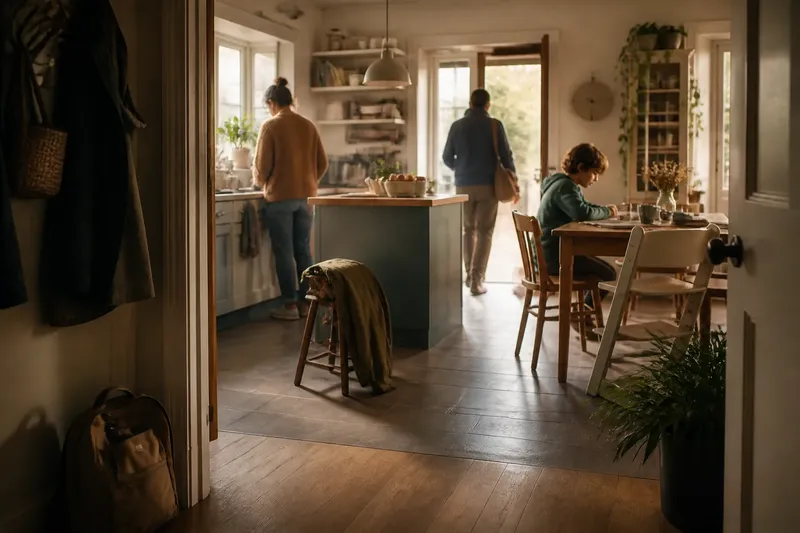
You cross the kitchen to make tea, stepping around a bag someone left by the door. A future walk through a familiar room begins with that ordinary route, not with a new colour scheme or a drawing of different furniture. The exercise asks what the room might be for, who might use it and how daily life could change.
Choose one room and imagine a specific, changed future. Then walk through the space at an unhurried pace, observing it as if you had arrived from that future. Your aim is not to plan a makeover. It is to notice which present-day choices rest on assumptions about how people live.
Which room suits the question you have?
Choose a room connected to a decision you can actually influence. A shared kitchen might suit a household thinking about changing routines. A meeting room could help a team consider how work might be organised differently. A bedroom may be useful when you are reflecting on privacy, care or changing household needs.
Let the question guide the choice:
- Choose a busy shared room if you want to examine who does what, and whose routines take priority.
- Choose a room with one main user if you want to explore how that person’s needs or responsibilities might change.
- Choose a room used for several purposes if you are curious about competing demands, such as quiet work and family time.
- Choose a room you rarely enter if you want to notice what its current use leaves out or takes for granted.
Skip a room that makes the exercise feel intrusive or uncomfortable. The point is to examine assumptions, not to expose another person’s private life.
What kind of changed future will make the walk useful?
A future should be different enough to unsettle a routine, but specific enough to imagine. Avoid a vague instruction such as “everything changes”. Instead, choose one shift that matters to your question: a new household member, a different pattern of working, a change in who provides care, or a community service moving nearby.
Say you want to understand how a kitchen might serve a household with more shared meals and less time at home during the day. That invented situation gives you something to observe: who arrives first, what needs to be ready, and whether the kitchen still works as a place to meet. The expected result is not a design solution; it is a clearer account of which routines and expectations deserve attention.
Keep the imagined condition visible in a short note. If it starts to sprawl into several unrelated changes, return to the one shift you chose. This keeps observations tied to a future you can discuss rather than to an assortment of dramatic possibilities.
How should you walk through the room?
Begin at the doorway. Pause before moving anything. Notice what draws your eye, what is easy to reach, what seems to belong to someone, and which routes people might take. A notebook or a voice memo is enough to capture observations; a quick sketch can help if the room’s paths or thresholds matter.
Now imagine entering as someone whose day has changed in the way you described. Move through the room slowly, stopping where a routine would begin or end. Ask who has access, who waits, who tidies, who makes decisions and who may not feel that the space is for them. These questions keep attention on use and relationships, rather than on finishes or furniture.
Notice absences as carefully as objects. A room may have no obvious place to pause, talk privately, leave a coat or prepare for a task. Do not assume that adding an object is the answer. First record what the absence suggests about the room’s present purpose and the people it serves.
Write observations as possibilities, not verdicts. “The room seems arranged for one person to prepare food while others wait” leaves room for discussion. “This room is badly designed” closes it down before you have asked who uses it and why.
What should you record rather than redesign?
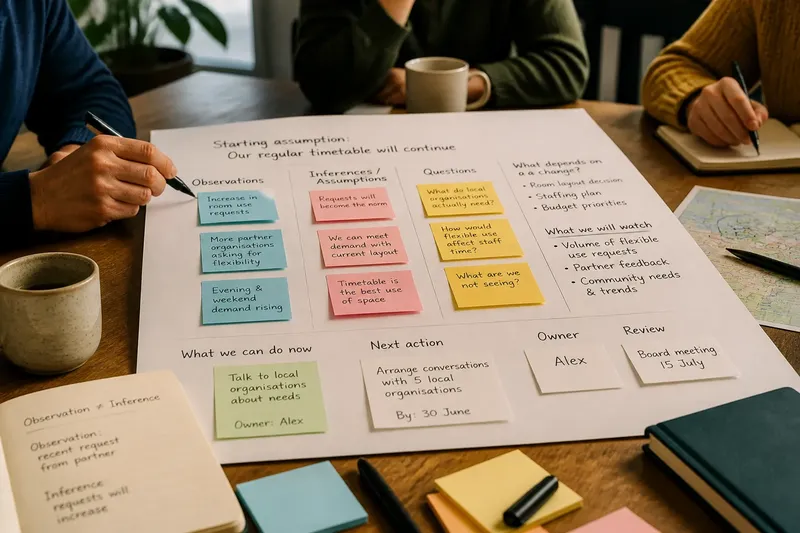
Keep a short field note with three parts: what you saw, what changed in the imagined future, and what question the difference raises. For example: “The table is used for sorting post; in the imagined future, several people arrive at different times; where could unfinished tasks wait without taking over shared space?” That note preserves the connection between observation and future condition.
You can also mark a simple room sketch with arrows for routes, circles for places where people gather, and question marks where a routine is unclear. This is a record, not a floor plan for renovation. Avoid turning the walk into a list of purchases or improvements. If a possible change occurs to you, write it separately so it does not crowd out the observation that prompted it.
After the walk, compare notes with someone who knows the room, if that feels appropriate. Ask what they recognise and what they would describe differently. Disagreement can reveal that one person’s “usual” route or responsibility is not shared by everyone.
Which questions help you interpret what you noticed?
How do I choose a future to imagine?
Start with a change already relevant to the decision you are considering, such as a shift in household roles or the rhythm of work. Keep it to one main condition so you can see how it affects the room’s use.
Should I move objects during the walk?
No; leave the room as it is and record what you notice. Moving things can turn observation into redesign before you have understood the routines or assumptions behind the current arrangement.
Can I do the exercise with other people?
Yes, if they are comfortable taking part and the room is appropriate to discuss together. Let each person describe their own route and tasks before comparing accounts, so one person’s version does not become the default.
What if the room seems unchanged in the imagined future?
That is still useful: ask which routines appear durable and who depends on them. Then check whether the unchanged room reflects a deliberate choice or simply an assumption you have not examined.
How can the walk inform a present-day choice?
Return to the decision that prompted the exercise. Separate your notes into what seems important across the imagined change, what depends on that particular future, and what remains uncertain. The distinction helps you avoid treating one imagined scene as a forecast.
Choose a modest next question, not an automatic intervention. You might ask a household member about an unspoken task, observe a routine at another time of day, or discuss whether a shared room is expected to serve incompatible purposes. If the decision affects other people, invite their perspective before acting on your interpretation.
A future walk through a familiar room is most useful when it changes the questions you bring back to the present. The room need not look different at the end. You may simply notice that a route, responsibility or expectation has been treated as permanent when it is only familiar.
Keep the notes with the decision they relate to. If circumstances shift, revisit the same room with a different future in mind; the comparison may show which assumptions have changed and which still shape everyday choices.