Paper Cards or a Shared Wall for Mapping Possibilities?
Paper cards or a shared wall for mapping possibilities? Choose a format that helps a group compare future scenarios, keep uncertainty visible and carry useful questions forward.
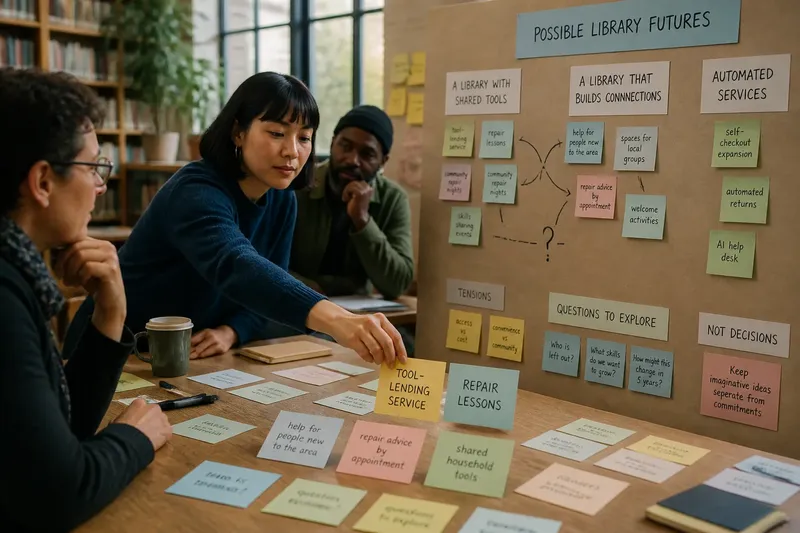
At a library workshop, a participant moves a note about a tool-lending service beside one about repair lessons. The shift suggests a possible way those ideas might work together, but it does not say what the library should do next. Paper cards and shared walls make different parts of this kind of futures work visible: one supports rearrangement, the other keeps an emerging landscape in view.
For mapping possibilities, the choice is less about which surface is better and more about what the map is meant to help people notice. A futures map can hold distinct scenarios, tensions and unanswered questions without turning them into a plan. The format should support that work while making its limits clear.
What should a futures map help the group see?
A map arranges ideas so participants can inspect relationships among them. A note might describe a possible future condition, name who could be affected, or pose a question about how a change could unfold. Its position can suggest a connection, but it should not quietly imply that one possibility causes another or that the group has endorsed it.
This distinction matters because a tidy arrangement can look more settled than the thinking behind it. A cluster may be a temporary way to compare ideas, not a forecast or a decision. Label the map’s purpose plainly, such as “possible library futures” or “questions raised by automated services”, and mark provisional groupings as provisional.
Cards separate each idea from its location, so people can move it and consider a new relationship. A wall makes the whole arrangement easier to inspect at once, especially when the map covers a broad topic. Both formats can support imaginative exploration; neither, by itself, makes a scenario more plausible or a choice more responsible.
When do paper cards serve scenario work?
Cards are useful while a group is still creating and comparing different futures. Participants can lay out separate scenario elements, regroup them, or place competing interpretations side by side. Index cards, sticky notes or cut-up sheets of paper are enough to begin.
Give each card one main idea. A concise heading and a clarifying phrase are easier to move than a paragraph that combines a future condition, its cause and a proposed response. Keep the card format consistent, so a long sentence does not appear more important simply because it occupies more space.
Movement can help a group see that one idea belongs to more than one possible future. It can also expose a hidden choice: placing “repair advice by appointment” beside “shared household tools” suggests a different service from placing it beside “help for people new to the area”. The card does not settle which relationship matters. It gives participants something concrete to question.
Loose cards can lose their context, particularly when a group returns to the map after a break. Add short labels to clusters and record important links with a line, an arrow or a brief note. If the arrangement needs to be revisited, take a clear photograph and add any spoken explanation that the image cannot preserve.
When does a shared wall help people compare futures?
A wall gives the group a common view of the map. People can stand back, compare clusters and notice areas that have received little attention. This is useful when participants need to refer to the same arrangement during a discussion or across several sessions.
Make the display legible and approachable. Put it where people can reach it without blocking movement through the room. Leave space between clusters, use writing that can be read from nearby, and provide removable notes or another simple way to suggest changes.
A wall can also make the difference between a possible future and a present choice easier to communicate. For example, a heading such as “a library with shared tools” can sit above scenario details, while a separate area holds questions the group wants to explore. Keep proposed actions somewhere else, so an imaginative possibility is not mistaken for an agreed commitment.
Visible displays can feel finished even when they are not. Invite participants to add, question or move notes directly, or provide a nearby surface for proposed revisions. A clear invitation to challenge the arrangement helps prevent the person who first wrote a note from seeming to own its meaning.
Which setup fits the futures session?
Choose cards when the group’s main task is to generate, combine or compare ideas. Choose a wall when the main need is to keep a developing landscape visible. A mixed approach can work when the group first explores freely, then wants a shared display to return to.
Before the session, consider the work the group will actually do:
- Will participants regularly regroup ideas? If so, use loose cards or removable notes; otherwise, a wall display may be simpler to maintain.
- Does the group need to compare several scenarios at once? If yes, leave enough visible space for distinct clusters; if not, arrange the ideas on a table or smaller board.
- Can everyone reach and read the display? If not, change its position, add a seated working surface or invite people to dictate a move to someone else.
- Will people return to the map later? If yes, photograph it and record the meaning of important connections; if not, agree what notes or questions need to be carried forward.
- Could a cluster look like an agreed plan? If yes, label it as a possibility and keep decisions in a separate area; if not, still make the map’s purpose clear.
- Are some ideas connected in more than one way? If yes, duplicate a note or draw a link; if not, keep a single placement and label the cluster’s shared theme.
How can a group keep possibility maps open to challenge?
Can one idea belong to more than one possible future?
Yes. Duplicate the note or draw a visible link if the idea matters in several scenarios. Keep enough context beside each version for participants to understand how its meaning changes.
What should the group do with an uncertain connection?
Mark it as a question rather than forcing a firm placement. The group can then explore what each possible relationship would imply without presenting either as settled.
How can a wall remain editable?
Use removable notes, leave space for alternatives and invite people to propose changes. If direct edits are difficult, collect suggested moves on a separate sheet and review them together.
What should be recorded after the session?
Keep the map’s clusters, important links and unresolved questions, not just a transcription of individual notes. Add a brief explanation of what the arrangement was intended to explore, so later readers do not mistake it for a forecast or decision.
How might a mixed format work in practice?
Say a fictional library group begins with twelve paper cards, each carrying one possible service or future condition. The cards include tool lending, repair advice, a quieter study room and support for people new to the area. Participants first sort them into broad themes, then notice that repair advice connects both to tools and to welcoming newcomers.
They keep that ambiguity visible by making a second copy of the repair-advice card and placing each copy with a different cluster. Next, they move the clusters to a wall, add a heading that marks them as possibilities rather than decisions, and leave a blank space for unanswered questions. Before finishing, they photograph the wall and write down why the duplicated idea appears twice.
The result is a shared reference that preserves more than one interpretation. It does not decide which service the library should pursue. Instead, it leaves the group with a clearer question to explore later: which relationship matters most in the possible futures they want to examine?
Paper cards or a shared wall for mapping possibilities is ultimately a choice about what the group needs to notice. Cards make changes of relationship easy to try; a wall helps people see the wider arrangement. Whichever surface you use, record what a placement means and what remains uncertain. That small distinction lets imagination inform present choices without pretending the future has already been decided.