A Scenario Needs a Tension, Not a Plot
A scenario needs a tension, not a plot: pair changing conditions to explore distinct futures and clarify which present-day choices remain useful across them.
A scenario needs a tension, not a plot. At a workshop table, a group may have a wall of ideas about the future of local food: rooftop gardens, delivery robots and empty shops turned into kitchens. Yet nobody can say what decision those ideas help with. The problem is often not a shortage of imagination. It is that the scenario has become a story before its underlying pressure has become clear.
A useful scenario holds two changing conditions in relation. One might be the cost of energy; another, the degree of public trust in shared infrastructure. Neither is a prediction. Their interaction creates a space in which different consequences can be explored, and in which choices made now become easier to examine.
Why does a scenario feel like a plot?
People naturally connect events. A workshop starts with a new technology, adds a crisis, then introduces a heroic response and a tidy ending. That sequence can be lively, but it may conceal the assumptions doing the real work. If the story depends on a single dramatic event, participants can dismiss it as unlikely rather than ask what it reveals about their decisions.
The usual cause is treating scenario work as fiction-writing. A scenario can include a moment or a character, but those details should expose the conditions around them, not carry the whole argument. Try removing the named characters and most of the events. If the future still has a recognisable structure because two pressures are pulling in different directions, the scenario has a stronger core.
What happens when the tension is too vague?
“Technology changes quickly” is a topic, not a tension. So is “people want convenience”. Neither says what is changing on the other side, or why the combination matters. The result is a set of broad claims that can fit almost any future.
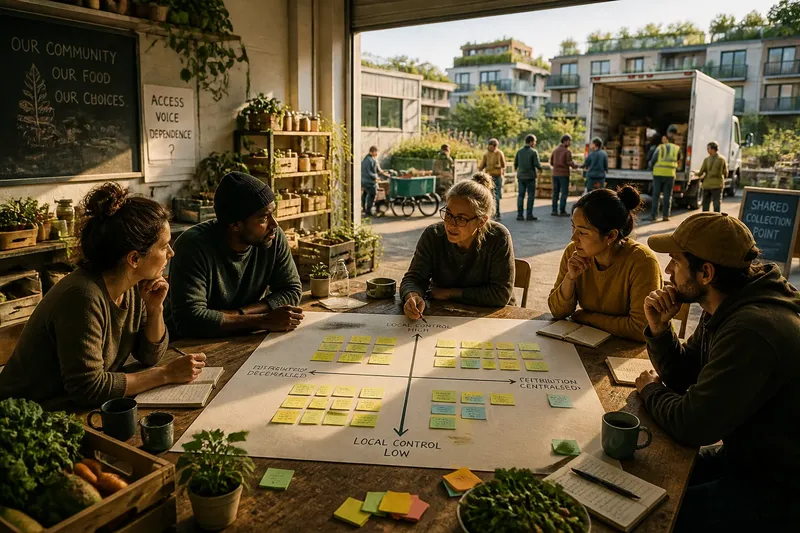
Use conditions that can move in different directions and that matter to the decision at hand. For a neighbourhood food service, one condition might be whether residents increasingly value local control; another might be whether distribution systems become more centralised. These are not opposites in a debate. They are separate uncertainties that can combine in more than one way.
Say a community group is considering whether to support a shared collection point for local produce. Imagine local control grows while distribution becomes more centralised. The group might ask whether a collection point can give residents a meaningful voice, or whether it would simply become the local face of a system whose decisions are made elsewhere. The observable result of the scenario is a sharper question for the present decision, not a claim about what will happen.
How can you tell whether the tension is useful?
A workable tension should meet three tests. First, both conditions should be genuinely uncertain rather than disguised forecasts. Second, each should affect the choice being considered. Third, they should combine to produce futures that differ in ways participants can describe and use.
- Check whether each condition is observable: if a label such as “resilience” has no visible expression in practice, rewrite it in concrete terms; otherwise, keep the condition as stated.
- Check whether the conditions are distinct: if one is merely a consequence of the other, replace one with a separate uncertainty; otherwise, retain both.
- Check relevance to the decision: if neither condition changes the choice under discussion, select a pair closer to that choice; if one does, clarify how it affects the choice.
- Check the combinations for different implications: if every combination points to the same action, sharpen the conditions or revisit the decision; if the implications differ, keep the pair for further exploration.
- Check that uncertainty remains visible: if the wording quietly favours one direction, make the range of plausible states explicit; otherwise, leave the wording provisional.
This is not a scoring exercise. It is a way to notice when a pair is too broad, too dependent or too remote from the choice. A tension earns its place by helping people think differently, not by sounding dramatic.
What if every combination feels like the same future?
This often happens when the conditions are worded as familiar trends rather than genuine uncertainties. “More online services” and “more digital skills” may both point towards an assumed direction. The workshop then produces variations on one future, with different scenery but much the same logic.
Try expressing each condition as a range of plausible states, without calling either end good or bad. For example, residents might have substantial influence over local food decisions or very little; distribution might be organised through many small networks or through a few large operators. Combining the ranges helps reveal where the group’s assumptions have been hiding.
If the resulting futures still converge, check whether the chosen conditions can actually alter the decision. A pair about packaging preferences may be interesting, but it may not help a group deciding how to organise distribution. Change one condition, not the whole exercise, and see whether the choice becomes more sensitive to the outcome.
How much story belongs in the scenario?
Enough to make consequences tangible, but not so much that the plot dictates them. A short scene can show what a condition feels like in daily life: a volunteer deciding whether a collection point still serves the people it was created for, for instance. The scene should invite questions about access, authority and dependence, rather than resolve them through a convenient character or surprise event.
Keep the wording provisional. “In this future, residents may rely on a shared collection point run by a large distributor” leaves room to examine trade-offs. “The distributor takes over the neighbourhood and residents lose control” has already chosen an outcome and tone. The first formulation supports inquiry; the second can turn discussion into a contest over plausibility.
How do you use tension without calling it a forecast?
Make the purpose explicit: the scenario is a lens for examining a choice, not a statement about what is most likely. Then ask what each possible combination would make easier, harder or more consequential. This keeps discussion anchored in present-day decisions while preserving uncertainty about how conditions may unfold.
Imagine a neighbourhood food group deciding whether to fund a shared collection point. For this invented situation, its starting assumptions are that residents may have either strong or weak influence over decisions, while distribution may be run through either small local networks or a few large operators. The group writes those ranges on cards, pairs each local-control state with each distribution state, and asks what each pairing would change about the collection point. If strong resident influence combines with small networks, members may decide to design the service around local choice; if weak influence combines with large operators, they may instead seek clear terms for accountability before committing. The exercise does not settle which future will occur. It shows that the decision depends on who holds authority and how the service is organised.
What questions help you shape a scenario?
Can a scenario have more than two changing conditions?
Yes, but begin with two so the relationship stays legible. Add another only when it changes the decision in a way the first pair cannot express.
Should the two conditions be opposites?
No. They need to vary independently enough to create different combinations, not sit at opposite ends of one argument. A contrast can be useful, but it is not a requirement.
What if one condition seems more likely than the other?
Keep likelihood separate from usefulness. A less familiar combination may reveal a vulnerability or opportunity worth considering, without being presented as the expected future.
When should a pair be replaced?
Replace it when the combinations do not change the choice, or when one condition is only a restatement of the other. A clearer pair should make different consequences visible.
A scenario needs a tension, not a plot, because a tension lets people examine how changing conditions might alter a decision without pretending to know the ending. When the central pair is clear, details can be added sparingly to make implications easier to discuss. The most useful last question is often modest: what would we want to notice now if this combination began to take shape?