Before the Forecast: Futures Thinking in the Workshop
Futures thinking in the workshop helps groups examine assumptions, turn uncertainty into useful questions, and make present choices without pretending to predict what comes next.
A planning meeting can begin with one sentence on a whiteboard: “Here is what will happen next.” Someone adds a date, others adjust the wording, and soon the room is preparing for a future nobody has questioned. Futures thinking in the workshop starts before that forecast hardens: it gives participants a way to examine the assumptions behind a choice.
This is not a history of how workshop methods developed. It is a look at what a well-framed session can do now: surface different views, make assumptions discussable and leave a group with a practical next move. The focus is not on building a catalogue of possible futures, but on how people work together when they disagree about what lies ahead.
What changes when a group questions its starting assumption?
A forecast may be useful for a specific decision. The difficulty comes when one expected outcome quietly becomes the only outcome the group is willing to plan for. Discussion then centres on adapting to that expectation, rather than noticing what the plan depends on.
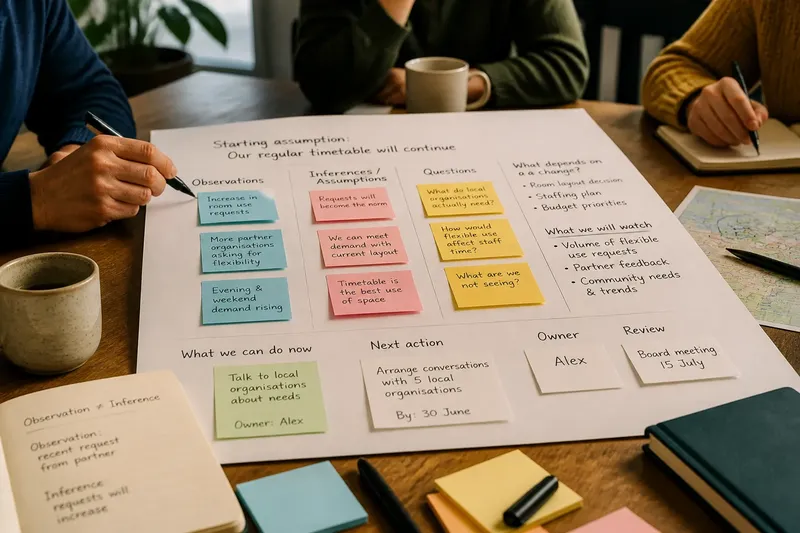
A facilitator can make the assumption visible by writing it down as a claim, then asking participants what they have observed and what they are inferring. The distinction matters: an observation might be a recent request from a partner organisation, while the inference might be that such requests will become the norm. Keeping those separate lets the group question its reasoning without dismissing the observation.
Imagine a community arts venue whose board assumes its regular timetable will continue. The board writes that assumption on a flip chart, then notes a recent rise in requests for flexible room use. It decides to ask local organisations about their needs before committing to a fixed room layout. The result is a specific information-gathering task, not a claim that the requests will continue.
How can a workshop make disagreement useful?
Disagreement often points to different experiences or assumptions. A resident may notice a change in local demand; a staff member may be concerned about available time; a partner may see a different constraint. A workshop can place these views alongside one another without requiring participants to settle them immediately.
Start with quiet individual writing before opening a discussion. Ask each person to record one observation, one assumption and one question connected to the decision at hand. Then sort the notes together. This gives less vocal participants a way into the conversation and helps the group see whether it is arguing about evidence, interpretation or priorities.
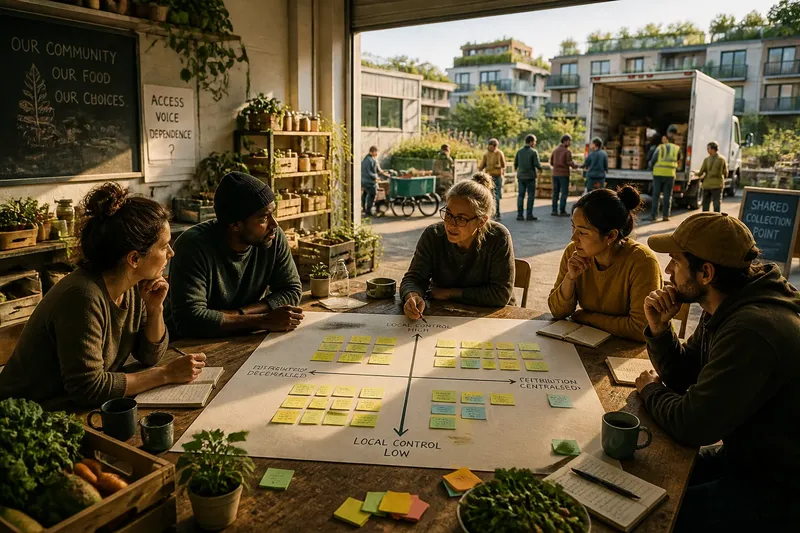
For instance, participants might disagree about whether a public service will become more centralised. The facilitator can ask each side to name the condition behind its view, then record which choices depend on that condition. The group may find that one decision can proceed either way, while another should wait for clarification. That record makes disagreement actionable without dressing it up as consensus.
What keeps imagination connected to a real choice?
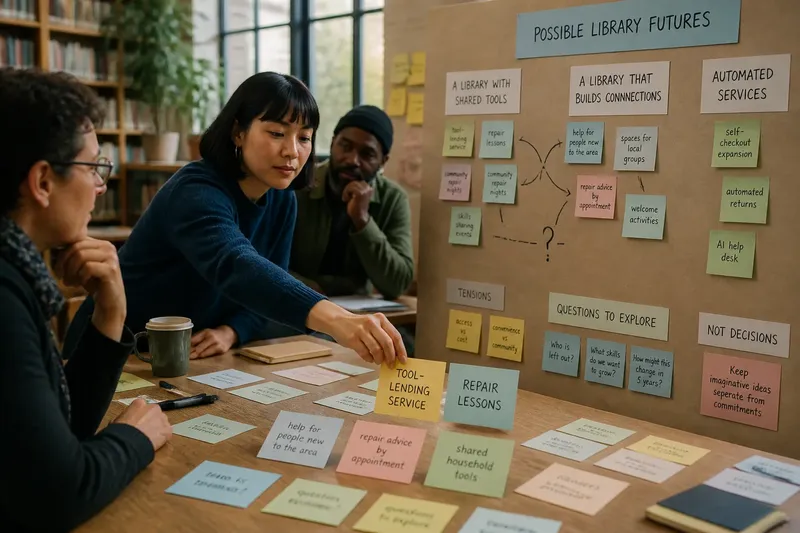
Open-ended brainstorming can produce striking ideas that do not help a group decide what to do. A useful prompt connects an imagined change to a practical question: what would this mean for a service, a relationship or a commitment the group can influence?
Say a neighbourhood library team is considering whether to rearrange its rooms. Its starting assumption is that visitors mainly need quiet access to books and computers. The team writes that assumption down, then imagines a plausible situation in which more residents ask for help using public services online. It maps the possible effect on staff time and room use, then decides to review its proposed layout with front-desk staff before approving it. The observable result is a decision to seek specific input, not a forecast about future demand.
Sticky notes, a paper map or a shared document can all support this work. Choose a format that lets participants see what has been recorded and change it as their thinking develops. The tool should serve the discussion, rather than make the session feel more certain than it is.
What should a group record before it leaves?
A lively conversation can fade once everyone returns to ordinary work. A short written record helps carry the reasoning forward. Use three headings: “what we can do now”, “what depends on a change” and “what we will watch”.
- Observation: Participants name a current decision the group can influence. If they can identify one, then record its owner and next action; otherwise ask what decision the session was meant to inform.
- Observation: A proposed action remains useful under the assumptions the group discussed. If it does, then place it under “what we can do now”; otherwise record which assumption it depends on.
- Observation: Participants disagree about a condition that could change the decision. If they can name the condition, then record what information would help clarify it; otherwise ask each person to state the assumption behind their view.
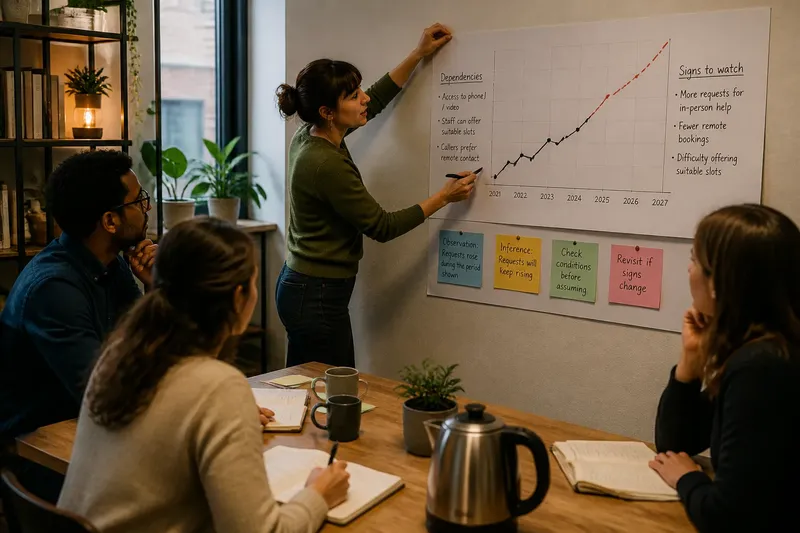
- Observation: A change would prompt the group to review its plan. If participants can describe a visible sign, then record who will notice it and when to revisit the choice; otherwise do not treat the imagined change as a monitoring signal.
- Observation: A proposed follow-up has a named owner. If that person accepts the task, then record the next meeting or decision point; otherwise leave the task unassigned and ask who has the authority to take it on.
- Observation: The notes distinguish what participants observed from what they inferred. If they do, then keep both in the record; otherwise label the statements before sharing the notes.
These checks are not a scorecard. They help the group leave with a clear distinction between action, uncertainty and attention. A sign to watch is a reason to reopen a question, not proof that one imagined future has arrived.
What questions help after a futures workshop?
How many perspectives should the group make room for?
Invite perspectives that could change how the decision is understood, rather than trying to include every possible viewpoint. If the discussion keeps returning to the same assumptions, ask who is affected but not represented in the room.
Does futures thinking replace a forecast?
No. A forecast can inform a decision, while a workshop can help participants examine what the forecast leaves uncertain and whose assumptions shape it. Make clear which of those tasks the group is doing.
How can a facilitator prevent confident voices from setting the frame?
Give participants quiet writing time before discussion, then invite contributions in turn. Ask for observations and assumptions separately so confidence of delivery does not stand in for a reasoned claim.
What should happen to the workshop notes?
Keep a concise record of the decision, assumptions, follow-up actions and signs that would prompt a review. Bring it back at the relevant decision point, and revise it if the group’s understanding changes.
How can a group carry the discussion into its next decision?
End by asking each participant to name one choice that looks different after the discussion. Then agree who will carry that question forward and what information, conversation or observation could help. If no choice has changed, ask whether the session clarified why the current plan still makes sense.
Futures thinking in the workshop is most useful when it leaves a group better able to explain its present choices. The practical gain is not certainty about what comes next, but a visible account of what the decision rests on and what would make the group reconsider it.